Can We Trust Digital Content?
The industry can't afford any compromise on consumer rights as we enter the digital age

It's not necessarily popular in all quarters, but there is a general acceptance that the transition to a digital future is underway. Plenty of debates still rage, primarily over the question of what exactly people are going to pay for (and in what manner they'll do so) in a world where little or nothing is distributed in physical form, but the crux of the argument - that physical product is on the way out - seems to be won. Even those who still believe in physical product admit that it's likely to end up as a niche product for enthusiasts, much like vinyl is for music fans today.
I'm among those who believe that this transition is inevitable. I'm a little too old to have lost my attachment to physical media entirely, but young enough to understand that it's truly a generational rather than a universal thing. I like having my movies and games in boxes, but digital music came along before I ever had a chance to build much of a CD collection, so there's simply no attachment for me there. I don't own a single piece of music in a physical format any more. This causes no pangs of pain to my heart, and I understand fully that for those a few years younger than me, games and movies are no different. Honestly, I'm going that way too - my DVD collection is about a third the size it once was. Even my bookshelves (which I suspect will be the final hold-out of non-digital media in my life) have shrunk.
"Consumer rights and corporate responsibilities in a digital world simply aren't defined or regulated in any sensible way"
Accepting that this transition is inevitable, however, doesn't mean that people have to be happy about how it's being managed - or about some of the things we're going to lose in the process. For years, we've been warned that digital products are pushing us into a place where consumer rights are far less clearly defined than they were in the physical age - that the natural rights which were conferred by physically owning an item are not guaranteed by having a copy of a file on your hard drive, or more likely, a license to access something that's stored somewhere in the Cloud.
To some degree, consumers have been willing to accept that trade-off. Services like Netflix, iTunes, Kindle and Steam have a superbly balanced proposition, one which encourages consumers to accept certain restrictions in return for a genuine improvement in their experience as consumers. They provide access to media in a flexible, powerful and usually competitively priced way that physical product can't rival, even if they also strip away certain important things like the right to resell things you own.
Besides, the logic goes, the worst case scenarios proposed by digital refuseniks are hardly likely to come to pass. Sure, digital distribution often includes methods by which a provider can remotely mess with your ability to enjoy a product - restrictive DRM which stops you loading it onto another device, for example, or more worryingly, the possibility that content you paid for will simply disappear tomorrow when the provider's DRM servers refuse to authenticate it. These are possibilities, but they're not relevant to most of us - are they?
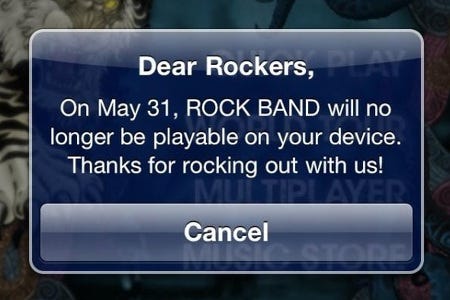
To that extent, blatant abuses of consumer trust like this week's Rock Band iOS debacle are exceptionally useful. Customers who had bought Rock Band iOS were informed this week that the game would stop working on May 31st - even though it's still on sale at full price in the App Store. EA has since backtracked after public outrage, but the fact that this is possible and was even considered is a good thing to have out there in the public eye. Without wanting to single EA out specifically (because there are other examples of this), this is a clear and fairly appalling example of a company mistreating its customers in a way which is only possible because of the digital nature of the product. If I buy a game, movie, album or book in physical format, there's no way for the publisher to decide one day that I can no longer play, watch, listen to or read it. They simply don't have the ability or the right to do that. Digital distribution, however, has conferred that ability and that right, and sadly it's inevitable that it will be abused.
EA isn't alone in abusing it. Amazon has been caught out quietly removing books from customers' Kindles. A sports video service backed by ESPN and Microsoft several years ago simply shut down, taking its DRM servers and customers' entire libraries of purchased videos with it. That's even before we get into the question of subscription services, a whole other minefield of supposed consumer rights and actual corporate realities. The point is that these things aren't hypotheticals - they happened, and while in the present climate (where digital is still only part of the market) the culprits have generally been quick to backtrack, it's not safe or wise to assume that'll always be the case.
"The danger of the digital future is that we could end up with an industry disconnected from its consumers and acting blindly in short-term self-interest"
This is the core problem. Consumer rights and corporate responsibilities in a digital world simply aren't defined or regulated in any sensible way, and corporations are only too happy to suggest that we should simply trust them not to be evil. Consumers are buying things that aren't really products, but are instead limited and restrictive licenses to access certain kinds of data under certain circumstances - and few consumers are aware of how quickly that rug can be pulled out from under their feet. "Just trust us," say the corporations, which is frankly an absolutely terrible idea. A gun on the mantelpiece in act one is always fired by act three. If corporations are given the right to play fast and loose with consumer rights, they will absolutely do that, no matter what they promise today. The only way to stop the gun going off is to take it off the mantelpiece to begin with.
That's not just in the consumer interest, though - it's also in the interest of creatives and even of the publishers themselves. We need to remember that the audience for digital content isn't a captive one. We're not talking about water companies or power companies or monopolies on food or fuel here - we're talking about a luxury, non-essential product, and worse, we're talking about a luxury, non-essential product that's easily copied at zero cost to the consumer (and there's not much in the way of fancy DRM that can stop that in the present market).
So what happens if consumers despair of being mistreated over digital content? What happens if the pricing is abusively high (looking right at you, Xbox Live Games on Demand) or the consumer gets burned by service being shut off unfairly? What happens if DRM imposes onerous restrictions on which devices you can use, or if the lack of any kind of resale value simply makes it unappealing to buy new products?
Simple. Consumers stop buying, or they pirate. There are other hobbies, other outlets, other ways to spend your money and your time - and plenty of consumers will vote with their feet and their wallets if the industry doesn't treat them well. More importantly, though, the industry needs to recognise that as distasteful as it may be, they are in competition with piracy. If media is easy to access at a fair price, piracy doesn't thrive - at least not among those who are willing to pay. If it's overpriced, hard to access, surrounded by barriers or just downright untrustworthy, then piracy starts to creep away from the audience who were never going to pay anyway (and those piratical antics are an irritation and little more), and into the audience who actually wouldn't mind paying (and whose engagement with piracy is a genuine business concern and a sign that you're doing something desperately wrong).
This is the danger of the digital future - the danger that we could end up with an industry disconnected from its consumers and acting blindly in short-term self-interest, in a manner which ends up making paying for digital content look untrustworthy and unappealing. If the media industries should have one mantra for the next decade, it's this - "make consumers trust digital purchasing". Lots of other hurdles also need to be overcome, but if that fundamental mantra is not adhered to, the next few years will not see a digital boom, but rather a bonfire of companies and creatives.