Tech Focus: Euclideon's Unlimited Detail
Digital Foundry quizzes Euclideon on its highly controversial point cloud technology
Is it real, is it actually anything new, or is just it vapourware? The release this week of an Unlimited Detail technology demo from new company Euclideon has been met with a mixture of positivity about the quality of the results and scepticism on its application in contemporary video games.
On balance, there's probably been more of the latter with Minecraft developer Notch outright calling it a scam before clarifying and conceding some points the following day.
We contacted the driving force behind the project, Bruce Robert Dell, who agreed to answer a series of questions we put together in consultation with game developers who've shipped many high-profile multi-platform games - exactly the kind of audience Euclideon wants to win over with its new technology.
So, a great chance for Euclideon to evangelise its tech and to address the mixed response of game-makers - but it's fair to say that this tech interview wasn't quite like any we'd carried out in the past...
Q: The first Unlimited Detail videos appeared in 2008, you popped up on Beyond3D to talk a little about your techniques, then went back into stealth mode. We heard more last year and now you're making waves with the latest demo. What's new over what we saw last year? Why make the new video?
Bruce Dell: Well I'm Bruce Dell, I run a little company in Australia that makes computer graphics. Last year we were just two people and I suppose we're what some people would call a 'garage job'. Since that time we've started a company, we have nine employees, we've received investors and got one of the largest grants in the country from the government. Our board of directors are some of the top people in Australian software, and our chairman of the board is the former CEO of one of Australia's largest technology companies. Having a proper company with employees has made a big difference.
Bruce Robert Dell narrates over his latest Unlimited Detail tech demo. While the video is new, the underlying tech is not - Dell presented demos to companies as far back as 2005, with contacts suggesting that he may have been working on this since the late 90s.
Q: What PC system spec were you running to produce the latest demo?
Bruce Dell: The latest demo was running on our office laptop which is 2GHz Core i7. It ran at 20FPS [at] 1280x720 purely in software without touching the 3D part of the GPU, but we certainly haven't added all our optimisation yet. I think next time you will be pleasantly surprised.
I could say we use less memory than what the current polygon system uses, but if I did that I think I'd exceeded my quote of unbelievable claims for the day. So we'll leave that for future demonstrations...
Q: John Carmack suggests that a current gen Xbox or PlayStation couldn't handle this - bearing in mind the processing and memory limitations of what is essentially six year old tech, could your techniques work at a sustained 720p at 30FPS?
Bruce Dell: Firstly I'd like to say that I greatly respect John Carmack. In light of the fact that we haven't released real-time demos, his statement is sensible, sane, reasonable, but incorrect. We have too much respect for Mr Carmack's contributions to the 3D graphics industry to speak negatively of him and understand his comments in the light of the graphics systems he is aware of.
Q: There have been explorations for next-gen voxel-based technologies, specifically Carmack and Jon Olick's Sparse Vector Octrees or Cyril Crassin's Gigavoxel. Are you aware of these techniques? How does your approach differ?
Bruce Dell: If you consider the real-time speeds of those technologies, then you would have to admit that they do differ from us quite greatly.
Q: Your technology is point cloud based. How are you filling in the gaps between atoms when the camera gets very close to an object?
Bruce Dell: This only occurs when you are standing very close to the object in question, and currently we have three different techniques to solve this problem. We're still deciding which of the three is best suited to filling in the gaps and which provides the best visual output.
Q: How does your system deal with rendering many, many objects at once? Is it rendering imposters for distant objects and groups of distant objects, then compositing those in 2D? How are you dealing with lighting and shadow in that case?
Bruce Dell: No, it's not like the present polygon systems where they build different objects at different distance, swapping them in and out. Unlimited Detail doesn't work that way. When it comes to geometry it really is unlimited.
Q: Does the engine rely a lot on temporal coherence (smooth camera movement) in order to maintain frame-rate? If so, how long does the first frame of any scene take to render?
Bruce Dell: [Laughs] That sounds like the sort of question somebody would ask if they were trying to get at all of our well-guarded secrets. But no, the particular tree you're barking up is the wrong one - all the frames take the same amount of time.
Q: Everything we've read seems to suggest this is a software-based solution, but is there any crossover with the GPU? Are you using a standard graphics API (eg. Direct3D/OpenCL/etc) or could you use a GPGPU paradigm (eg. DirectCompute/CUDA/OpenGL/etc)?
Bruce Dell: At the moment we're running everything very well in software alone, however, we're a greedy bunch and seeing as more power is available in the GPU why not use it? I'm sure in time we will make more use of that.
Q: In the video there appears to be little lighting or material variation on display so far. How do you plan to address these issues to bring these features in line with competing game engines? Is this technology compatible with current deferred lighting techniques?
Bruce Dell: When it comes to lighting, as we said in the video, it's not quite finished yet. Unlimited Detail is a geometry system, like polygons are a geometry system. Lighting is something separate. We have working examples where Unlimited Detail is using the lighting from the graphics card - they are entirely compatible. However, we're also working on a few lighting techniques of our own which you will see in the future.
Q: What information can be stored for each atom? What are the memory requirements for a large scene such as your island?
Bruce Dell: If we were making our world out of little tiny atoms and had to store x, y, z, colour etc for each atom, then yes it would certainly use up a lot of memory. But instead we've found another way of doing it. I could say we use less memory than what the current polygon system uses, but if I did that I think I'd exceeded my quote of unbelievable claims for the day. So we'll leave that for future demonstrations.
Q: The scenes in the video show many instances of the same object repeated around the scene. Is this lack of variation a limitation of the technology, or just of the demonstration island scene?
Bruce Dell: Several weeks ago, we decided that we needed a demo. Our aim was to show the technology, not necessarily beautiful graphics, I think we succeeded in our task, it's not a limitation of the technology, it simply came down to not having enough time to make more objects. We only have one artist and the poor guy has been slaving away to the point that even Cinderella would have pity on him. Please don't accuse him of too much laziness. As said before we're a technology company not a games company - that is all the art that could be included in the demo in such a short amount of time.
Q: Your technology supports laser scanned objects and you talk about a mixture of "fictional" and "non-fictional" items making up the game world. What would be the cost of the hardware required? What sort of space would be required in a games development studio to use this method?
Bruce Dell: Regarding the scanning in of objects, we have much to say on this topic, but we would prefer to wait until our next video in order to best answer this question. There are a variety of different ways to scan in objects and they come in a variety of different costs. Studios will decide what suits them and their budget, or subcontract out their work instead.
We aren't actually trying to get great attention or credibility until our product is finished. Our intention was to put a little video on YouTube to tell our fans and supporters what we had been doing this year - we never expected it to get 1.5 million views in three days.
Q: How compatible is your system with the vertices/skeletal animation/surface texture approach we see now?
Bruce Dell: I think we are criticised the most in the area of animation. Yes we can do animation, but it's not finished yet. Last time, we learnt that if we were to put anything on the internet that wasn't finished, there would be hordes of forum people who are more grumpy than that donkey from Winnie the Pooh who would point the finger and say, "look at that, that doesn't look as good as polygons" no matter how hard we tried to say, "but we're only half done". I'm sure our supporters understand the wisdom of us being silent on the topic of animation until it's completed. I think when it comes to animation you will all be pleasantly surprised at what we've achieved.
Q: When converting models from polygons to your format, are you simply storing an atom for each point in the texture along each polygon surface, or is there a more sophisticated technique at work?
Bruce Dell: Well I don't want to speak too much on our technique at this point in time, but regarding polygon conversion, originally we were seen as the enemy of polygons, we constructed shapes out of little atoms, they were constructing shapes out of flat panels. The games developers we were in contact with didn't want their development pipeline to be adjusted radically. This makes sense when you consider all the current artists, their skills and technique, and the fact that the current tools in 3Ds max, Maya and others are very, very good.
So instead, we decided the best way forward would be to build a polygon converter. In effect what you have is a system that is converting polygons to little atoms, and then running those little atoms with our Unlimited Detail technology. But to the artist, they feel like they're just using unlimited polygons, their pipeline hasn't been changed in any huge way.
Q: Bearing in mind that the current paradigm is polygon-based, isn't it the case that tessellation is the natural progression for generating unlimited detail?
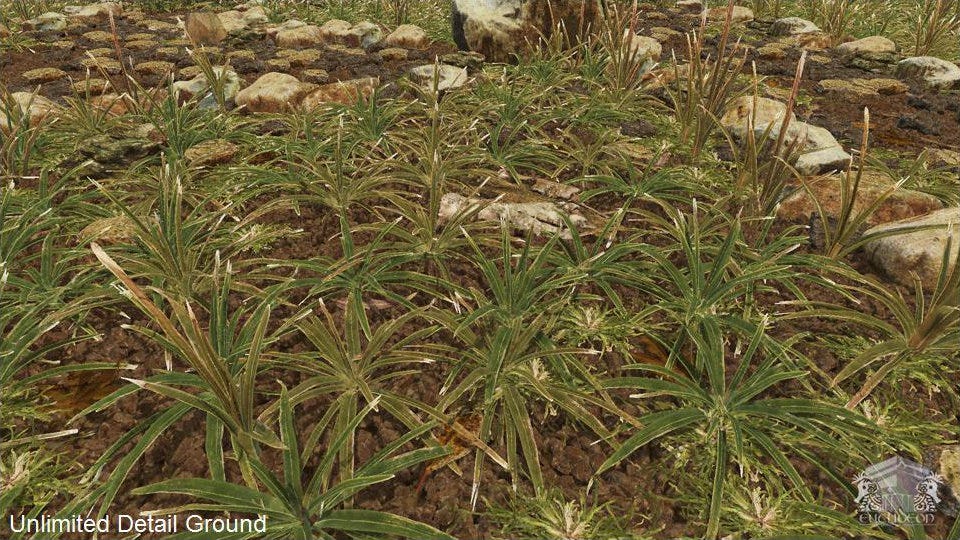
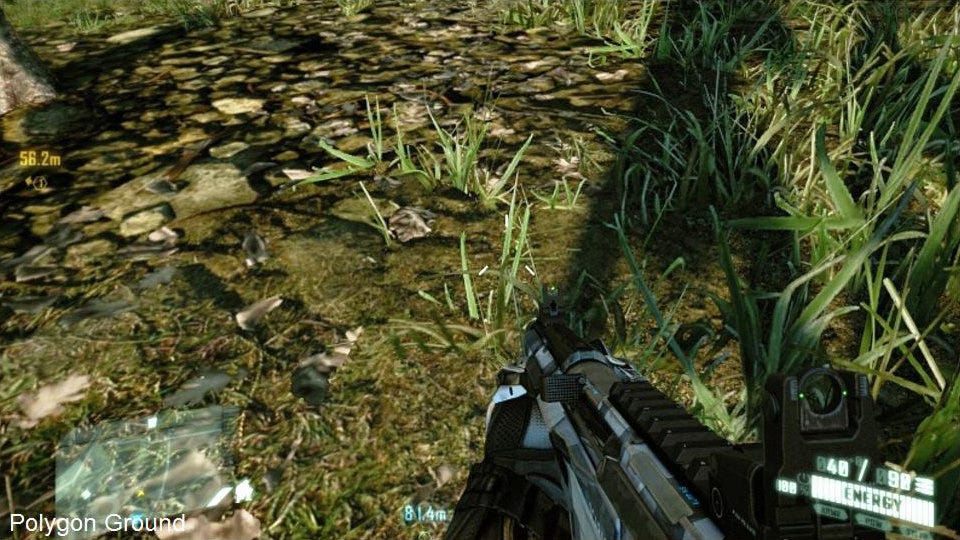
Bruce Dell: Tessellation is nice, I like tessellation, it was a proposed solution to the problems with low polygon counts and it was designed by some clever people who tackled the problems that the present polygon system brings in a very good way, but no I don't think that tessellated height bumps are better than real geometry if you put the tessellation picture next to unlimited detail there is a pretty big difference. Also an increase of height doesn't make blades of grass. Even if we came out four years from now and tessellation was actually used in games I still think infinite converted polygons would win over bumpy pictures.
Bruce Dell reckons that tesselation can't provide anything like the same level of detail as his technology but lifting a screenshot from the DirectX sample browser as he has here isn't the best example - this hails from a simple tutorial and doesn't really represent the results gamedevs can get from tessellation in DX11.
Q: Looking forward, what stands in the way of getting this technology out to game makers now? What's left to complete?
Bruce Dell: I'd like to answer that, but I know that anything I say, regarding what we're still working on, there will be people who point and say "Ha! They are still working on it, it's not finished! It will never be finished!" and do the dance of joy rejoicing in our interpreted destruction.
Looking over the responses, it occured to us that Bruce was rather evasive on many of the questions, and in some cases provided answers to questions we didn't actually ask. We put it to him that some of his comments may polarise opinion rather than clarify how the technology actually works, and asked him if he would like to expand upon any of his replies. His response may perhaps put this interview more into context:
Bruce Dell: I know this might sound strange but at this time we aren't actually trying to get great attention or credibility until our product is finished. Our intention was to put a little video on YouTube to tell our fans and supporters what we had been doing this year - we never expected it to get 1.5 million views in three days. The negative scam sentiment surprised us at first but then we realised it probably helps.
When we are finished and release real-time demos, perhaps there are some points for us in the fact that so many people were so wrong about us. As for clarification, I think the tech community are asking [if it's] a voxel system, a splat system or ray-tracing and are trying to get enough info to box us as something known. The fact that it's not any of those systems and doesn't resemble any of those systems isn't the answer people are looking for and I am not about to try and hand over all our secrets at this point in the project.
As I said in another interview: we're not quite finished yet, and we feel a bit like a mother who's put cookies in the oven, and the children keep pulling them out and eating them and saying "they don't taste right". Give them some time and the cookies will taste just fine.

I think I know why his cookies example is wrong. Cookie dough is one of the most delicious things. Icrecream and entire products have come out of it. It really makes him sound disingenuous.
Posted:A year ago