In Theory: The Challenge of the Ten-Year Lifecycle
Will we still be playing PS3 and Xbox 360 in 2016?
Recent rumour-mongering that both Sony and Microsoft would be announcing next-gen hardware at this year's E3 has brought into sharp focus the oft-repeated claim that both Xbox 360 and PlayStation 3 were designed with "ten-year lifecycles" in mind.
"Andy (House) is absolutely right in that we are not making any announcements at E3. I've always said a 10-year life cycle for PS3, and there is no reason to go away from that," Sony CEO Kaz Hirai told the Wall Street Journal during CES in response to the latest round of rumours. Hirai was referencing an earlier denial that SCE president Andrew House delivered to CVG.
"I don't think we're contemplating talking about anything to do with future console iterations at this point," House said.
While we fully believe Kaz Hirai when he says there'll be no PS4 at E3 2012, the implication that Sony's current home console won't be replaced until 2016 is almost certainly a red herring.
"But one thing I always point to is that, somewhat in contrast to our major competitors, we have, particularly with PS2, managed the length of the lifecycle and ensured its profitability for our publishing partners for a much longer lifecycle than has been true of the competition."
While Hirai's statement regarding a PlayStation 4 no-show is fairly unambiguous, it's safe to say that the lifespan of the PS3 or indeed the Xbox 360 has only a limited bearing on the timing of the announcement of any next-gen successor. While we fully believe Hirai when he says there'll be no PS4 at E3 2012, the implication that Sony's current home console won't be replaced until 2016 is almost certainly a red herring. History has demonstrated that console generations overlap and there is no firm cut-off point between between one console and the next, something that House is clearly acknowledging.
To illustrate, PlayStation 2 continues make money for Sony five years after the launch of the PS3. Despite the launch of new hardware, key products such as Guitar Hero and Singstar continued to drive purchases for the cheaper console and the PS2 market is still considered serious enough for Electronic Arts to produce a version of FIFA 12 released just a few months ago. Clearly the glory days are over, but the PS2 still has a role to play in emerging markets.
From a manufacturing perspective, there's nothing to suggest that both Xbox 360 and PlayStation 3 couldn't follow the same pattern going forward. As with PS2, the internal components of both platforms will be shrunk down and crammed onto ever-small slices of silicon, bringing down associated costs and allowing Sony and Microsoft to produce ever-smaller, cheaper, cooler boxes. It's an ongoing process that has already seen both consoles receive mid-life refreshes that have crammed their innards into much slimmer boxes.
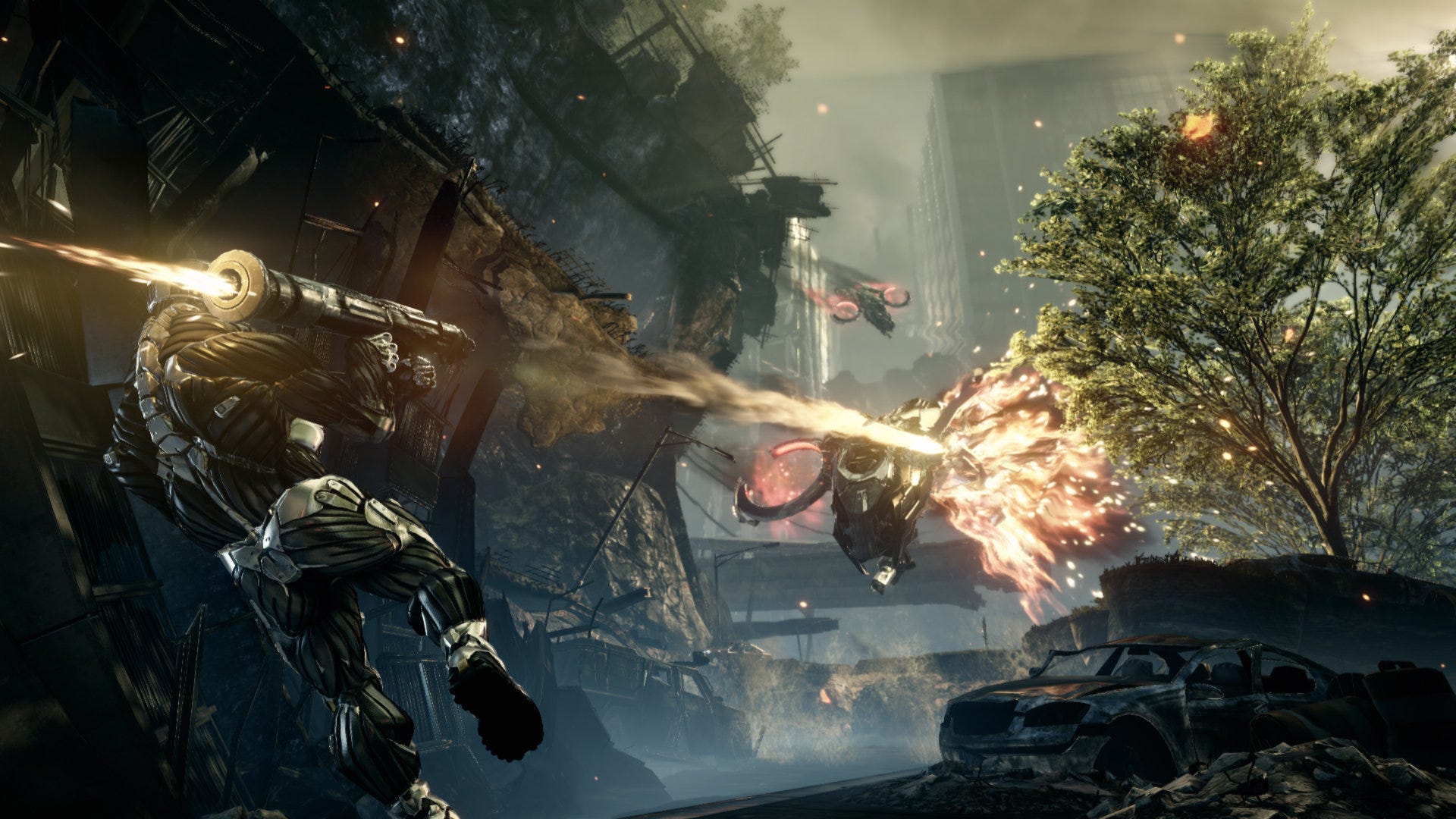
There will be more commonality between current-gen and next-gen platforms than there were between PS2 and PS3, and enginer-builders like Crytek (Crysis 2 pictured) are already working on cross-generational game technologies. This in itself could help PS3 and 360 to endure even when their replacements have been launched.
As it is, the consoles are currently operating with a 45nm fabrication process for its critical CPU and graphics chips, but Microsoft has already managed to incorporate both components into a single chip - just as Sony did with the PS2 during its transition into its "Slim" form factor. As fabrication technology improves, so the current-gen consoles will drop in size still further. Last year's "next-gen" job-postings from Microsoft - including a Senior Hardware Design Verification Engineer - are just as much about making the Xbox 360 cheaper and more efficient to produce as they are about manufacturing a next-gen console. Logically the next step will be transition the current designs onto 28nm production processes, but that's likely to take quite some time - perhaps another factor in extending the lifespan of the current generation of consoles.
From a software development perspective, until next-gen rendering techniques dominate, there'll be a period of transition where we expect to see multi-platform games cross the generational divide. Both EA's Frostbite and Crytek's CryEngine 3 are designed to handle both current-gen and next-gen architectures with developers approaching the platforms in much the same way that low-end and high-end PCs can handle the same games, just with differing levels of visual accomplishment. I suspect there will be far more technological commonality between current-gen and next-gen than there was previously - another factor that could help extend the lifecycle.
PS3 and Xbox 360 face both stern challenges and new opportunities compared to the PS2, which trounced all opposition and dominated the entry-level console space. We'll see stiff competition from the likes of the new Smart TVs, which will contain their own gaming platforms along with access to cloud gaming services such as Gaikai and OnLive. Samsung even has some plans to make their own Smart TVs upgradeable, allowing for low-cost, system-on-chip and presumably RAM upgrades. The idea here is that you won't have to replace your entire screen in order to keep up with the latest technology - and being Android-based, we can assume this will include gaming.
There's also the notion that smartphone technology in general - be it contained in handsets, tablets or indeed TVs - could supersede current generation consoles fairly quickly. Some believe that the top-end A9600 version of the upcoming Sony Ericsson NovaThor chipset could finally see mobile tech reach the same approximate level as the Xbox 360 and PlayStation 3, thanks in no small part to IMG's PowerVR 'Rogue' chipset. Whether this will actually translate into competitive software clearly remains to be seen, but if the mobile market opens out into the living room via Smart TV technology, it could change the entire gaming landscape. The emergence of Unreal Engine 3 on mobile platforms is the first indication that current-gen tech could converge with mobile.
Timing of any next-gen announcement will be crucial. Revealing a next-gen successor calls time on the current, profitable hardware and focuses the attention of the core audience on the future rather than the present.
However, the existing home consoles have advantages of their own to help them weather the storm in that they are not static, fixed-platforms like the PlayStation 2 was in its day - they can evolve easily. Via firmware upgrades, the Xbox 360 and PS3 can be radically transformed in terms of functionality - indeed, we've already seen it happen more than once over the last few years. PS3 has expanded to support 3DTVs and operates beautifully in concert with the PSVita handheld and has always been the Blu-ray movie player of choice, while the Xbox 360 has undergone two drastic revisions of its front-end, first with NXE and more recently with the 'Metro' dashboard update which repositioned the 360 as a conduit for streaming video in addition to its position as a core gaming platform.
Indeed, recent rumours that the next-gen Xbox would arrive in two SKUs - a set-top box with Kinect functionality and a fully-fledged 360 successor - lead me to wonder if the current console itself, evolved, repackaged, and repositioned, may well be one of those SKUs. If the main job of the machine is to stream in HD media via the internet, there is absolutely nothing to stop it working on a Cloud-style basis to bring next-gen Xbox titles onto current-gen systems - only the support for the rumoured bundled Kinect 2 could cause issues there.
The recently launched 'Metro' dashboard for Xbox 360 highlights the direction Microsoft is heading with the Xbox 360 - as a more rounded set-top box for both video streaming and gaming. In theory there is no reason why current Xbox hardware couldn't stream next-gen gaming using OnLive-style tech...
Embracing Cloud as part of its next-gen strategy could work for Microsoft. The platform would save an absolute fortune on loss-making hardware just for starters, and instead earn money via pay-per-play transactions and subscription packages. In terms of the system's suitability for hosting a Cloud-based gaming environment, the bottom line is that Xbox 360 has already proved that it can both stream and decode h.264 video so that's not really a problem. Indeed, behind closed doors at E3 2010, David Perry and the Gaikai team were demonstrating perennial favourite World of Warcraft operating quite nicely on an Xbox 360 devkit, proving conclusively that it can be done. Of all the major platform holders likely to embrace the Cloud, it's Microsoft that has the resources to create the infrastructure required and the in-house personnel to make it happen.
As a streaming platform, the Xbox 360 could easily live on to 2015 and beyond, as a Cloud-based portal to all manner of movie and gaming, with Kinect titles - which probably wouldn't need the sophistication of next-gen architecture - downloaded onto the system via Games on Demand and run using the existing 360 technology. At the same time, core gamers would most likely be satisfied with the more advanced second SKU, a more traditional piece of console hardware that would provide the high fidelity experience that audience demands, bypassing the latency and image quality issues that are almost certain to persist with streaming gameplay.
In terms of just when we will see actual replacements for the Xbox 360 and PlayStation 3, sources suggest that work is significantly further advanced on the Microsoft console than it is at Sony. I wouldn't be at all surprised to see something from the Nextbox team at E3 this year. The recent news that Crytek's first party Kinect title Ryse appears to have switched onto the next-gen platform strongly suggests that Microsoft will be ready sooner rather than later. With regards PlayStation 4, I'm told that work is still at the early stages on crucial elements of the developer toolset at Sony's R&D offices, so there's little reason to question the denials from Kaz Hirai and Andrew House about a potential E3 reveal.
Timing of any next-gen announcement will be crucial. Revealing a next-gen successor calls time on the current, profitable hardware and focuses the attention of the core audience on the future rather than the present. Certainly for Sony - with a raft of high-quality first party exclusives in the pipeline including a new game from the God of War team at Sony Santa Monica, plus Naughty Dog's The Last of Us, calling time on the current-gen PlayStation this year doesn't really make sense...

All those non-gaming functions of the 360 and the PS3 work just as fine on a $35 Raspberry Pi. Why would you need a $250 console for that? (Streaming games, videos and surfing a few sites and social networks)
Sure, Sony can absolutely sell a 10 year old device. The question is merelyto whom and whether the people who bought a PS3 early in its life-cycle might buy something else for the very same reasons they bought a PS3, or not. GameStop will not wait a single day to push a new generation of Microsoft consoles in exchange for Sony hardware. That will take a lot of early adopters and players of so called hardcore titles off the market and put a lot of cheap consoles on the market.
The Sony Move does not appear to be to the PS3, what Singstar was to the PS2 in Europe.
Posted:A year ago