Tech Focus: Modern Warfare 3 vs. Battlefield 3
Digital Foundry on the technical merits of the year's biggest shooters.
After the months of aggressive marketing, week one sales suggest that the biggest battle in video games is perhaps over before it has really begun. Based on week one figures, the stark reality is that EA's Battlefield has sold less than a quarter of the amount of units shifted by Call of Duty: Black Ops last year - meaning it would require a monumental drop-off in sales performance for MW3 to be in any way comparable. The biggest video game face-off of the year appears to have concluded with a whimper rather than a bang.
Doubtless, EA will be taking heart from the fact that it doubled its sales year-on-year in comparison with Medal of Honor, and blitzed its previous totals from all previous Battlefield releases, but it's clear that despite the trash talk and the enormous marketing budgets, it's going to take a catastrophic failure on Activision's part not to once again achieve sales domination with Modern Warfare 3.
But what of the respective merits of the games themselves? From a product development point of view, how does the new DICE epic rate against (take a deep breath) Infinity Ward, Sledgehammer and Raven's collaboration?
The FPS genre is akin to a technological arms race - the best shooters push back new frontiers to serve up a unique gameplay experience.
At Digital Foundry we often equate the first person shooter genre to a technological arms race. In their own way, games like Call of Duty and Battlefield, not to mention worthy contenders like Killzone 3, Halo: Reach, Rage and Metro 2033 are responsible for some of the most impressive rendering advances we've seen on console hardware. All of them push back new technological frontiers in order to serve up a unique gameplay experience.
It's safe to say that the arms race continues apace with the new Battlefield and Call of Duty offerings. On the face of it, the DICE game innovates from a technological angle in many different ways, while Modern Warfare 3 is much more of an iterative improvement on the existing tech - though it too serves up some nice new surprises we were not expecting.
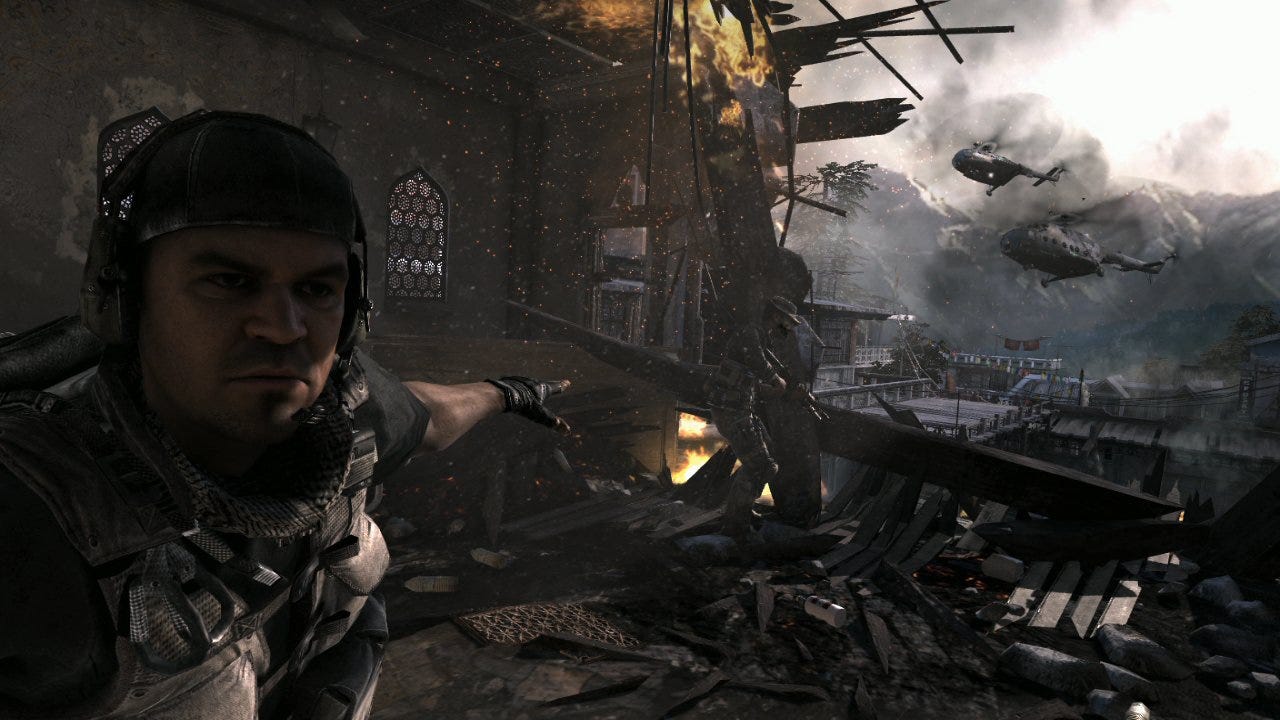
Improved character modelling, animation and some nice-looking particle effects work constitute some of the additions made to the stalwart Call of Duty engine.
In terms of sheer ambition, DICE's new Frostbite technology is nothing short of astonishing. Exercising the potential of the DirectX 11 APIs that developers fully expect to be a core component of the next-generation Xbox, Battlefield 3 produces beautifully lit environments using a tile-based deferred shading technique, allowing for hundreds of different light sources to be in play at any given point. Point lights, lens flare, emissive particles - watching Frostbite render out Battlefield 3's most intense scenes is an absolutely remarkable experience, especially on PC.
The destruction model is also second to none: DICE creates environmental detail from a series of linked meshes that break apart with a remarkable level of fidelity, while terrain deformation ensures that big bangs have the appropriate impact on a ground level.
Perhaps the most impressive element of the game is the support for maps large enough to support a total of 64 players (dropping to 24 on console). DICE has implemented a new streaming system that allows for new texture and mesh data to be streamed in on the fly, resulting in an extreme level of detail over vast expanses of space. It's virtually seamless on PC, and while LOD popping is an issue on console, the performance is much improved over the disappointing multiplayer beta DICE released just a few weeks before the game hit retail and the developer has only enriched its reputation for ultra-high detailed texture work and superb rendering of materials.
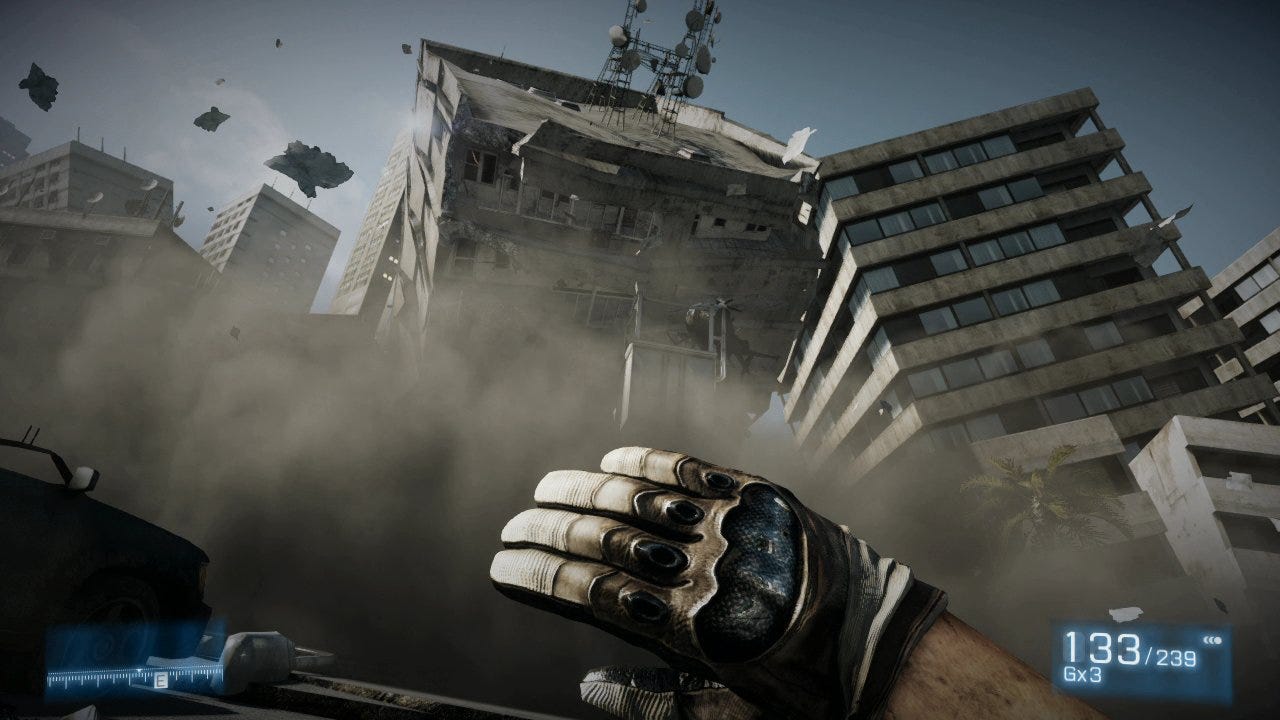
Battlefield 3's real-time destruction model is absolutely phenomenal - MW3 manages to pull off effects very similar in single-player cut-scenes with some really impressive scripting.
Modern Warfare 3 may lack the sheer technical wonderment of Battlefield 3 - and certainly on all of the key points we've just highlighted, the game comes up short in comparison - but many will argue that the overall quality of the final game more than justifies the enormous sales it's going to achieve. DICE has pursued the purist's approach we might expect from a technology-driven developer but Infinity Ward/Raven/Sledgehammer's take is a mixture of a deft engine upgrades and astonishingly good technical and art direction.
Let's tackle the engine upgrades first - lighting, reflection and water effects have been significantly improved, there's a beautiful new system in place for dealing with particle rendering, and animation is much smoother and more realistic, working in concert with character models that are more detailed than they were in Modern Warfare 2.
While the flexibility of the destruction model isn't really a patch on what see in the Frostbite 2 engine, the MW3 developers can be proud of the explosive environmental work they've done in their new game: remarkably, their single-player campaign seems to have far more in the way of destructible scenery in its showpiece engine-driven cut-scenes than DICE has in theirs - a great example of more ambitious, more exciting scripting and direction.
However, while the perception is that Battlefield has a lot of catching up to do to challenge the Call of Duty franchise, it's clear that Infinity Ward and Sledgehammer have taken some inspiration from DICE on both macro and micro levels. The "HDR" audio developed for Battlefield: Bad Company 2, which dynamically mixes and adjusts audio according to context gets its own take in MW3, making it easily the most audibly satisfying Call of Duty to date. We also see some small, neat ideas developed by DICE reduxed for MW3 - for example, masking loud noises (in this case an explosion) using thunder with a cue provided by lighting is a direct homage to the excellent sniper focused section from the Bad Company 2 single-player campaign.
The overall impression you get from playing both single-player campaigns back to back is that the advantages DICE has in terms of its technology have not been transformed into gameplay that makes the most of them - even the showpiece destruction technology seems to be limited and toned down compared to what it is capable of in multiplayer mode. On the flipside, the Modern Warfare 3 achievement is remarkable: the campaign is fast and indeed furious, beautifully paced and teeming with interesting scenarios and variety. What is may lack in technical advancement is more than made up for by the action and the gameplay.
The Modern Warfare 3 development teams have also managed to retain the series' trademark 60FPS gameplay: while it is somewhat short of the sustained, zero compromise frame-rate promised by Infinity Ward "Creative Strategist" Rob Bowling in his tweets over the summer, the game is clearly far more responsive and arcade-like than its DICE equivalent.
As the next-gen draws closer, DICE and EA are well-positioned to fully capitalise on the immense potential of its beautiful new Frostbite 2 technology
From a single-player perspective at least, the difference between Battlefield 3 and the new Modern Warfare is remarkable - while the comparison of new tech vs. an established, reinvigorated engine is intriguing, it's the surrounding elements that really make the Activision game what it is: excellent production values, a story that makes sense, a non-stop breakneck pace, tons of variety, some great ideas (zero G gunplay in a plane plummeting to the ground - yes!) and a sense of polish that is definitely missing from DICE's game.
Where Battlefield holds a key advantage over Call of Duty is in its wonderful rendering of vast, open spaces - particularly evident in multiplayer.
The achievement is all the more remarkable bearing in mind the respective positions of the BF3 and MW3 developers as they started work on their respective projects - DICE has been making these games consistently for many years now but Battlefield 3 is rife with issues, offering up sub-par single-player and co-op modes, while Activision's disparate development teams - cobbled together in the wake of Infinity Ward's implosion - has managed to hand in an ultra-slick, assured game that truly delivers on all levels.
It may well be that the production of the Frostbite 2 engine - carried out to a certain extent in tandem with Battlefield 3 - may have caused issues as the studio finds its feet with its fresh new tech. However, going forward, the advantage DICE and EA have is that the second game using the engine will almost certainly be a significant improvement over its first. There's also an undeniable sense that DICE is future-proofing itself against the transitional period we have coming up in the next couple of years.
We can get a taste of the challenges that face Activision going forward by checking out the PC version of Modern Warfare 3. Suffice to say it's a world apart from the experience offered up by Battlefield 3: shorn of its frame-rate advantage on PC, the game simply doesn't compare from a visual perspective: textures are of a remarkably lower resolution, effects work is far more basic and console-like, and the lighting model lacks much of the fidelity found in DICE's game. It's a game of extremes - the scenes that look spectacular on console look even more remarkable on PC, while the plainer, more basic elements simply don't stand up to scrutiny when scaled up to 1080p or higher resolutions. The unavoidable conclusion is that MW3's console focus is so tight that freed from the sub-HD console confines (both 360 and PS3 run at 1024x600 native res), the assets simply don't really work very well.
On PC, MW3 seems to exaggerate the strengths and indeed the weaknesses of the console-focused art and technology. Open levels like this can look superb, but interiors in terms of detail and lighting can look very old.
What we're seeing here with these two games is a clear difference in priorities: DICE has scaled down its PC tech to work on current generation consoles, while Modern Warfare scales up for PC, with only very limited success. Bearing in mind that the vast majority of its sales will be on console, it's doubtful that Activision will be too upset about the shortcomings of the PC game, but it's difficult not to believe that Battlefield will be offering a far more robust challenge to the current market leader when next-gen consoles appear in 2013. Frostbite 2 is simply incredible today: by the time new hardware is available, it's going to be even better.
In the here and now, Activision can congratulate themselves on the creation of the quintessential console shooter - a superb value package that delivers in all three of its major modes: campaign, co-op and multiplayer. For its part, Battlefield 3 isn't the same consummate all-rounder, but it's still one hell of a good online shooter, and different enough from Call of Duty to enjoy phenomenal success in its own right - and going forward, as the next-gen draws closer, DICE and EA are well-positioned to fully capitalise on the immense potential of that beautiful Frostbite 2 technology...

Brands, ads and using glitches in the customer's psyche (Completionism, Patriotism, Fitness, etc.), that is what is creating top tier sales today. Graphics might not be totally unimportant, but if you look at the costs of great graphics, the relative impact on sales does not seem to be there and this article proves it.
Posted:A year ago